Sunday, August 7, 2011


Vesta Flag, of the Main Asteroid Belt
Asteroid Vesta Flag

Vesta is one of the brightest asteroids in belt, you can even seen it in the sky with the naked eye from time to time.
Vesta is nearly spheroid almost putting it in the dwarf planet category, but not quite.
NASA's Dawn spacecraft entered orbit last month on July 16, 2011.
Vesta with Vesta Flag on it

The flag of Vesta has a black background. Along the fly is a multicoloured rainbow stripe of Vs. The colours are red, orange, yellow, green, indigo, navy blue, purple, and violet. Near the fly is a circle with a large black V. The stands for Vesta.
Snow Man of Vesta decorated

Here is the 'Snowman' crater. The Snowman has yellow lemon eyes, an orange carrot nose, a green pickle mouth, red apple buttons, a purple and violet scarf, the brown wooden branches as arms and a navy blue top hat.
433 Eros Asteroid Flag
Picture of Eros

Like the great monolith from 2001 a Space Odyssey, Eros tempted mankind to reach up and out towards new frontiers, by using the magnificent power of the mind.
Eventually Asteroid Eros 433 (S-Type) became a perpetually parking space for NEAR Shoemaker Spacecraft.
Coincidentally this ship made the first soft landing on an asteroid on February 12, 2001. The Near Shoemaker spacecraft worked on the asteroid for 16 days, until February 28, 2001.
Greek Image of the Erotic God

In honor of the grand event in humanity, this asteroid certainly deserves a flag of its own. It was originally named after the the Greek God of erotic passion. The Romans were so enchanted by this Eastern God of the Greeks that their own God of Love came into reality - Cupid.

Eros Flag 'planted' on Asteroid Eros 433


Like the great monolith from 2001 a Space Odyssey, Eros tempted mankind to reach up and out towards new frontiers, by using the magnificent power of the mind.
Eventually Asteroid Eros 433 (S-Type) became a perpetually parking space for NEAR Shoemaker Spacecraft.
Coincidentally this ship made the first soft landing on an asteroid on February 12, 2001. The Near Shoemaker spacecraft worked on the asteroid for 16 days, until February 28, 2001.
Greek Image of the Erotic God

In honor of the grand event in humanity, this asteroid certainly deserves a flag of its own. It was originally named after the the Greek God of erotic passion. The Romans were so enchanted by this Eastern God of the Greeks that their own God of Love came into reality - Cupid.
Flag for the Eros Asteroid 433

Eros Flag 'planted' on Asteroid Eros 433

Jupiter Flag, King of the Planets
Flag of Jupiter

The flag of Jupiter has a metallic brown background. There are four white stripes that represent the four major moons discovered by in 1610 by Galileo Galiei.
The symbol of Jupiter is a combination of three symbols - the astrological symbol for Jupiter, the open Egyptian Eye, and finally the Chinese Symbol for the planet. The red disc in the hybridized eye is reflective of Jupiter's Giant Red spot.
The coincidence that the largest planet of our solar system aligns with the paramount god of Roman Mythology is uncanny. This distant planet has acted as our cosmic guardian by sweeping up potentially deadly asteroids or comets that could have destroyed life on earth.

Jupiter is the proverbial eye of the solar system on constant watch, defending earth from asteroids, comets, and rouge planets. Jupiter seems to have its own life force and an eye focused on defense of earth.

Sedna Flag, Outer Dwarf Planet
Sedna the Dwarf Planet Flag
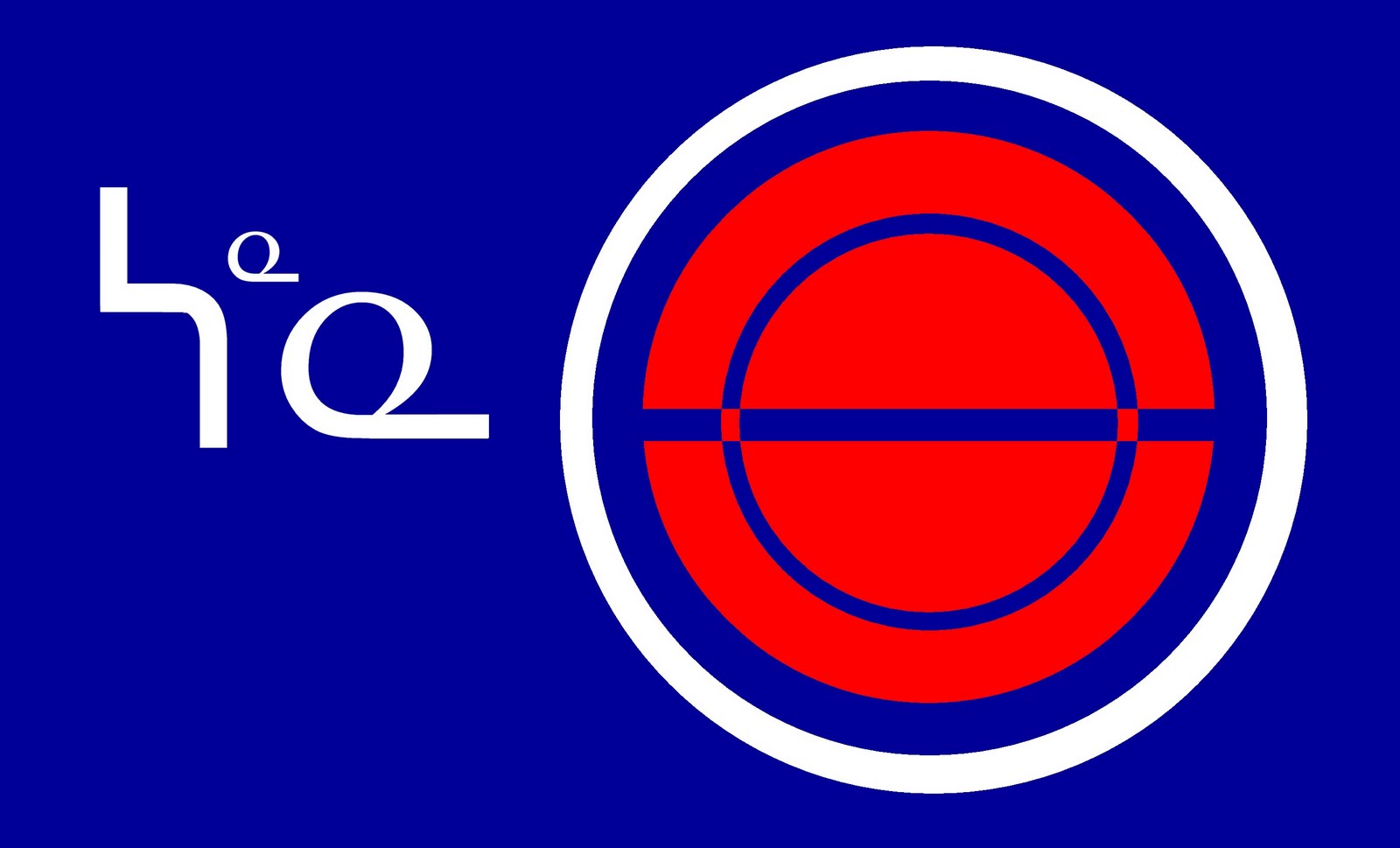
The red planet from afar whose yearly trip around the sun lasts about 11,400 years. It was discovered on November 14, 2003. It was discovered by an Alabama native - Mike Brown. The last time this planet came close to our humble abode is when wooly mammoths roamed the earth.
The flag of Sedna uses the colours red, blue, and white. The name of Sedna is written in a Native Canadian Inuit script known as Inuktitut, which would be read a 'Sanna' instead of Sedna.
Sedna or Sanna is the Inuit (Eskimo) Goddess of the Sea and marine animals. Since planet Sedna is so far away it is assumed to be very cold just like the arctic. However relative to Sedna, earths polar regions are flaming hot spots in our solar system. The Goddess Sedna would probably find the planet Sedna too cold.
A sun rise on Sedna with Sedna's Flag

This 'dwarf planet' it approaching its closest point to earth, the last time it was at a 'close' approach to earth was during the Upper Paleolithic period.

Ganymede Flag, Moon of Jupiter
Flag of Ganymede
Moon of Jupiter
Moon of Jupiter

It's only fitting that the largest planet in our solar system gets the largest moon - Ganymede. Ganymede takes it name after a Trojan Prince whose beauty seduced Zeus. Subsequently this love of Zeus became his cup bearer.
The colours of the flag are red, white, and pink. There are four pink triangles that symbolize Ganymede as one of the four great moons of Jupiter.
Also the pink triangle is associated with gay love, and the relationship between Zeus and the Trojan Prince qualifies in some sense as gay relationship. If not in reality but certainly symbolically.

The largest moon in our solar system is bigger than
Mercury
Callisto Flag, Moon of Jupiter
Flag of Callisto

This is the flag of Callisto. It employs the colours brown, black, white, and indigo. Brown and black refer to the mythological Callisto that was turned into a bear and eventually became the constellation Ursa Major - or rather the 'Big Dipper'.
Callisto is Jupiter's outer most moon and about the same size of Mercury.
Callisto Outer Moon of Jupiter

Oberon Flag, Moon of Uranus
The Flag of Oberon
Moon of Uranus
Moon of Uranus

This flag represents Oberon and uses five colours - black, yellow, white, green and red. It is based upon the flag of Electorate of Brunswick-Luneburg which is where astronomer who discovered this moon was born - William Herschel.
Mr. Herschel discovered this moon on January 11, 1787 after he had emigrated the United Kingdom.
In the upper hoist area is a dog ear design with a black field and yellow star. The black represents deep space while the star represents this moon. The colours black, yellow, and white are in honor of the subsequent nation that has cultural claims upon the birthright of person who brought the moon Oberon to our attention in 1787 - William Herschel.
The horse is rotated 90 degrees in reflection of Uranus' highly tilted orbit, which puts this planet and it's moon at a relatively odd angle relative to its orbit.
Puck Flag, Dwarf Moon of Uranus

Puck the moon was discovered back in the future in 1985, orbiting appropriately around Uranus. Puck is a fun loving and mischievous forest sprite that loves to dance.

Tatania Flag, Moon of Uranus
 Flag of Tatania
Moon of Uranus
 TATANIA
This flag represents the moon Tatania which can be found orbiting Uranus. This moon is named upon the imagination of William Shakespeare's Fairy Queen - Tatania.
Uranus is the non-conformist planet of our solar system that rotates nearly perpendicular to its orbital pathway. This has given the moon's of Uranus a very unique point of view, since their orbits cut out of the 'normal' groove of rotation.

View from Tatania
with Ariel-Umbriel eclipse and Uranus in the background
Ariel Flag, Moon of Uranus
Flag of Ariel
Moon of Uranus

The moon Ariel was discovered by an English Astronomer on October 24, 1851. This flag represents this moon and is based upon the elements of the British Union Jack and emblems associated with Manchester, since the founder of this moon may have been a Manchester United FC fan if he were alive today - William Lassel of Bolton, England.
The altered union flag is rotated 90 degrees to represent Uranus and its moon's nearly perpendicular side ways view of the solar system.
The colours of Ariel's flag are black, yellow, red, and white. The devilish emblem is holding an astrologically based Uranus shaped pitch fork, instead of regular pitch fork.
An imagined view from Ariel with Miranda eclipsing the sun

Logo of Manchester United

Persons who live in Bolton today are often Manchester United football fans.

Europa Flag, Moon of Jupiter
Flag of Europa

This is the flag of Europa the glacier moon of Jupiter. The colours of this flag are indigo, blue, white, and orange. It is essentially a horizontal tri-bar with orange fimbration along the central indigo stripe.
In each of the main stripes are symbols. In the top white stripe is Chinese symbol for Jupiter which also means wood and Thursday.
The colours are reflective of Europa's natural colours, and assumed ocean or submerged glacier.
In the middle is the indigo stripe with Europa written in Phoenician since Europa was originally a Phoenician Princess. This translation is based upon an English to Phoenician translation. If a Greek to Phoenician code would have been used there would have been no Phoenician A. This was done to honor another letter of the ancient and semi-living Phoenician Alphabet.

On the bottom is a blue stripe with the horns of a white bull, which is related to the story of when Zeus turned himself into a white bull to seduce Europa.
IO Flag, Moon of Jupiter
Flag of IO
Moon of Jupiter
Moon of Jupiter

The flag for IO the moon of Jupiter is composed of four colours - red, orange, yellow, and black. They are reflective of IO's bright colours.
The Moon of IO
it has a yellowish tint

IO is where the first volcano was detected that did not occur on earth. It is one of the four great moon's of Jupiter.
In Greek Mythology IO is a princess nymph who gets turned into a cow. She is often depicted as a cow in art work.

Triton Flag, Moon of Neptune
Flag of Triton
The Titan Moon of Neptune
The Titan Moon of Neptune

This is the flag of the moon Triton, Neptune's largest moon. It uses the colours black, white, indigo, blue, and dark sea green.
The two conch shells are reflective of the god Triton, and the blue crescent is the planet Neptune.
A view from Triton

Charon Flag, Siamese Dwarf Planet
Flag of Charon
the lesser twin of the Pluto System

The flag of Charon is actually a Twin Dwarf Planet on the outer rim of our solar system. So nebulous is it's identity it threw the astronomical universe upside down for a while back in 2006.
When Pluto was demoted to a Dwarf Planet, Charon was subsequently no longer considered a moon by many astronomers. Reason being that the center of gravity between Pluto and Charon is not in a planet but rather somewhere in between, albeit closer to Pluto. Thus Charon is a Dwarf Planet.
The flag of Charon uses four colours: purple, navy blue, black and white. This flag has a strong counter charge aspect. The taller figure is the God Charon, the ferry man to underworld. The sitting black figure to the right represents a person crossing over to Hades. The boat is also shaped like a moon to denote Charon's bi-terminal status as a 'moon.' The staff of Charon is black and white denoting the elemental dichotomy between life and death. Near the upper hoist is the symbol of Pluto.
Flag of Charon proudly flying on a 'Pluto-Rise'


Rhea Flag, Moon of Saturn Flag
Flag of Rhea

Saturn's moon Rhea was discovered in 1672 by Giovanni Domenico Cassini of the Genova Republic.
Rhea may be of the few moons to have its own moon, or rather mini-moon. There is evidence that Rhea may have rings or at least had them recently. But there is no conclusive data that confirms this idea.
But this phenomenon leads us to the question of what to name a moon of a moon? Mini-moon, Poon, or Moonernoid. Astronomers have yet to find such a 'nip-noom' object, but surely they exist.
Image of Goddess Rhea
with two lions at her sides

The flag of Rhea uses the colours blue, purple, and pink. In the central space is a large blue disc and the astrological symbol for Rhea. The symbol is composed of two Leo symbols on the lower left and right, in the upper middle position a female symbol pointing up.
This symbol is reflective of the Goddess Rhea's depiction in a chariot or thrown with two lions. The female symbol related to her association as the Mother of other Greek Gods.
If Rhea the Moon does indeed have small asteroid like 'moons' in orbit, appropriate names would be Simba, Scar, Mufassa, and other fictional lions from Hollywood and imagination land.
In the middle of the flag is horizontal blue line with two blue dashes. These are meant to by stylized female symbols pointed east and west, and coincidentally a chariot. Along the fly and hoist are two vertical blue stripes to represent her wide open heart as the cosmic mother to her offspring Gods.
Imagined View of from Rhea
with theoretical ring and companion "niperoon" Mufasa
(Mufasa was played by James Earl Jones in The Lion King 1994)

Subscribe to:
Comments (Atom)