Translate
Saturday, February 18, 2017
Thursday, February 16, 2017
Substitute to Morse Code Flag Correspondence
If you look at your average International Maritime Code Flag chart they will often have substitute/repeater flags listed. Since it would be cumbersome to have multiple flags, substitute flags were created that repeat certain positions.Morse Code is often put next to the flags, but there is little relationship between Maritime Signal flags and Morse Code. Nor is Morse Code listed for any of the signal to the substitute flags. Likewise many websites often forget to list the 4th position substitute.
But finally today, we have Morse Code Substiute Flags and Morse Code prosigns to go along. These flags are based upon three letters, always starting with S for Substitute which has three stars. Consequently the Morse Code flag for 1st Substitute is SST; the first S comes from Substitute and the ST comes from st in 1st.
Unlike the other Morse Code flags that have their colour code based upon the order of the spectrum, the colours of Morse Code Substitute flags follow the colour pattern already established by International Maritime Flags.
Tuesday, February 14, 2017
Morse Code Flag Chart A to Z and the Numbers 0 to 9
Note that International Maritime flags are usually written with Morse Code. But those maritime flags are not really Morse Code, and have no bearing to the dashes and dots of Morse Code.
In essence these flags are reflective of the Morse Code signal. Likewise the added colour reveals the ones digit position of each letter. Since the Morse Code flag for the letter A, K, and U all have a number 1 in the ones position via 01, 11, and 21, they are all red flags. Consequently the flag for number 1 is red too.
The order of colours to number is based upon the progression of the visible spectrum. Since yellow is the 3rd colour, we get a yellow coloured flag for flags in position 03, 13, and 23, which represent C, M, and W.
Also each colour has set contrast indicator to reduce confusion. See the image below to see which contrast indicator belongs to each specific background colour.
Also note Morse Code flags are always read downwards. Although some cultures read from the left and others from the right, every culture reads downwards.
Sunday, February 12, 2017
Fun Flag for Plutonium: Element 94
The Fun Flag for Element 94, Plutonium is based upon flag state flag for California but with several modifications. Since this element was first created in California, the California state flag dominates. But a leading quartet of four men were responsible for the genesis of Plutonium. The primary fathers of Plutonium were from Michigan, Iowa, Texas, and fatefully California. Dr. Glenn T. Seaborg was born in Ishpeming, Michigan; Arthur Wahl was born in Des Moines, Iowa; Joseph W. Kennedy was born in Nacogdoches, Texas, and by providence from Redondo Beach, California we have Edwin McMillan.
Consequently elements from their respective state flags are a part of the Fun Plutoniun Flag. Instead of telling what they are, I'll just let yous figure it out for yourselves. If you do, please feel free to comment on the post!
Pluto the planet was discovered February 18, 1930. Plutonium was identified on February 23, 1941, but later was given a birth date to December 14, 1940- after chemical analysis. Likewise Pluto the Dog was created and later named after his creation. Pluto the Dog appeared in The Chain Gang 1930.
After Pluto the Planet was named, the unnamed dog from The Chain Gang received his name - Pluto. Neat thing is that Pluto the Plant, Pluto the Element, and Pluto the Dog were all named a while after their first appearance, and all three were discovered by and in the USA, making this a Plutonian Hat-Trick.
Fun Flag for Uranium, Element 92
The Fun Flag for Uranium is based upon the flag of Germany. It is due to the scientific pursuits of Martin Heinrich Klaproth while in Berlin that this material was recognized as an atomic elemental. This atomic element was named after the recently discovered planet of Uranus.
There is an intense JFK-Lincoln like synchronicity about this deadly and beautiful atom. Both Uranus and Uranium were discovered by German born scientists. Heinrich Klaproth was born in Wernigerode which is now Saxony-Anhalt, while the discoverer of Uranus, Friedrich Wilhelm Hersechel was born in Hanover which is now Lower Saxony.
Uranus was discovered on March 13, 1781 during the same year the first government of the United States was legalized on March 1, 1781 via the Articles of Confederation.
Uranium was discovered in 1789 the same year the second government of the United States was legalized on March 4, 1789 with the US Constitution.
The first nuclear weapon that utilized Uranium was used by the United States, as its government was synchronized to the discoveries of the atom and planet. And finally, nuclear fission was discovered by German born scientists Otto Hahn and Fritz Strassmann, and its theoretical explanation by Lise Meitner and Otto Frisch.
Saturday, February 11, 2017
Fun Flag for Element 58- Cerium
The Fun Flag for Cerium, Element 58, combines the flags of Sweden and Germany. Reason being, this matter was independently and coincidentally recognized in the same year, 1803, by Sweden and Germany. Jöns Jakob Berzelius and Wilhelm Hisinger of Sweden, and Martin Heinrich Klaproth of Germany were the first three humans to sense and describe the scientific element of 58 protons, but it was the Sweden's Berzelius who named this atom Cerium. Berzelius named it after the recently discovered planet of Ceres, which was recently visited by the NASA's Dawn probe in 2015.
Fun Flag for Palladium, Element 46
The Fun Flag for Palladium is based upon the English Flag. Reason being, an English Scientist, William Hyde Wollaston, discovered this element in 1802. He named it after the newly discovered planet Pallas. Consequently the planetary symbol for Pallas makes up the central portion which looks like a female symbol but with a central square instead of a circle.
Thursday, February 9, 2017
Southern Britain and Northern Ireland UK Flag, Upon the Scottish Exit
![]() |
| Fade to Welsh/Cornish Black Conservative Switch |
Southern Britain and the Republic of Northern Ireland may become a reality in the near future if Scotland ever leaves the United Kingdom. Thus UK has several flag options to choose from in the event of a Scotexit. Additionally with the coat of arms, the Welsh Dragon will certainly replace the Unicorn.
![]() |
| UK Flag, English Expression |
![]() |
| UK Flag, Wales Expression |
The more black flag which expresses Welsh and Cornish colours and is a more conservative change, that retains the original UK flavor.
![]() |
| UK flag, Wales Major Expression |
English German Heritage Flag
The German-English Heritage Union Flag represents persons who share links to both Germany and England.
English French Mixed Heritage Flag
The French-English Fusion flag is for events and persons who are mixed English and French. Usually an intense rivalry for most as is the case with Korea and Japan, but many times great love and harmony and love can exist between the English and French. In this case persons who are mixed up with both English and French heritages genetic or not can fly this flag of love.
Fun Flag for Helium, Element Number 2
The Fun Flag for Helium is based upon a combination of the English and French Flags. The English Red Cross takes center stage while the background colours of France are recessive. In the center is a shield with the symbol of the Sun which also acts as an element of Helium with two electrons.
Helion, or rather Helium, was first noticed as a separate element by a Frenchman in India, Jules Janssen, but it was an Englishman, Norman Lockyer, who first to gave it a name, and both events coincidentally by providence took place in 1868. Lockyer named this element after the Sun God from the Greeks, Helios.
Fun Flag for Selenium, Element 34
The Fun Flag for Selenium is based upon the Swedish national coat of arms. Instead of three golden crowns we have three golden atoms, and instead of red rubies we have red electrons. The symbol of the moon is in the crest position and the colours of Sweden are shown, blue and yellow.The Fun Selenium flag has a moon upon it since it's namesake is the Greek for the Goddess of the Moon- Selene.
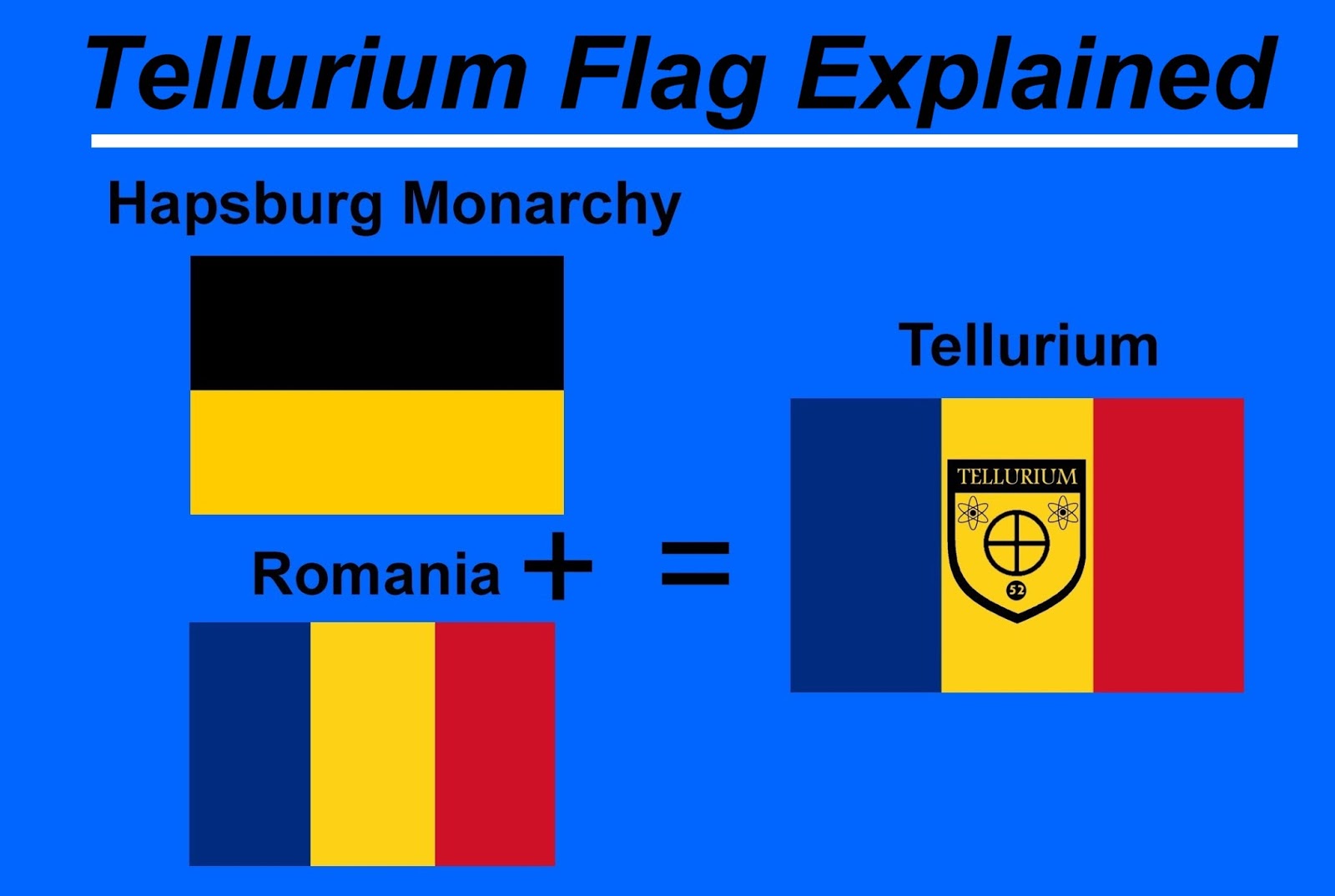
Fun Flag for Element 52, Tellurium
The Fun Flag for Tellurium is based upon the flag of Romania, since this element was discovered there, during its Austrian Hapsburg phase. Likewise the central coat of arms are black and yellow which are related to the Austrian Hapsburg Era colours.Also note since Tellurium is named after the planet Earth, we have the symbol of Earth in the center with two atoms up top and its atomic Z number on the lower portion. Like a proper set deck of cards, Tellurium is Oxygen's second cousin, leaning towards the transgendered element, being both masculine metal and feminine organic-wood.
Coincidentally the pattern of Romania is repeated in Africa with the nation of Chad and two more times in Europe with Andorra and Moldova. The Earth symbol by synchronicity reflects four different corners of the Earth that carry the "Romanian-Earth" colours: Romania, Chad, Moldova, and Andorra. They are so many unused national flag patterns, like they could have modified the order or use a different pattern? Nope, it was by fate that these four nations would use the blue, yellow, red vertical tribar, how graceful now, considering the genesis of the Fun Tellurium Flag.
Tuesday, February 7, 2017
Fun Flag for Copper
The Fun Copper Flag is based upon the flags of Cyprus, which is where the word copper is derived from. The copper and green colours are based upon the flag of modern day Cyprus, as is the olive branch. Likewise the lions are based upon the old British colonial ensign. Finally red is also taken from the Northern Cyprus flag as well.
The three lions symbolize that this element was known to the ancients, as it was in Africa, Asia, and Europe before the rise of the Roman Empire or Great Walls of China. Under the green lion is the Egyptian word for Copper, under the red lion is the Chinese word for copper, and finally under the copper lion is the English word for Copper. Just above the olive branches is the atomic Z number for copper, 29.
Monday, February 6, 2017
Fun Flag for Manganese, Element 25
The Fun Flag for Manganese combines the colours of Sweden and Greece. This element was articulated in scientific detail by a Swedish person, but it gets its namesake from the region of Greece known as Magnesia. Also note that Magnesium-Element 12 is also named after this special region of Greece.
Sunday, February 5, 2017
Fun Hafnium Flag - Element 72
The Fun Hafnium Flag combines the flags of Denmark, the Netherlands, and Hungary. Reason being this element was discovered in Copenhagen, Denmark in 1922 by a scientist from the Netherlands, Dirk Coster, and another from Hungary, Georg von Hevesy.
Hafnium gets its name from the Latin name of Copenhagen, consequently the Danish banner makes up "Haff of the Hafnium" Flag. Coincidentally the flags of the Netherlands can be seen on the fly side, while the Hungarian flag is on the left.
Note that Hafnium is the Latin name for Copenhagen and this element will soon turn 100 in 2022.
Fun Flag for Rhenium, Element 75
![]() |
| Coat of Arms Rhineland |
Not to be confused with element Rh, for Rhodium, which gets its name after the colour of a rose, assuming a red rose.
Tuesday, January 31, 2017
Fun Flag for Indium Element 49
The fun flag for Indium, Element 49, is based upon the old Colonial German Flag which was once a part of the East Indies, or rather the Spanish East Indies. This flag reminds us that Germans were responsible for the discovery of this new material in our universe: Ferdinand Reich and Hieronymous Theodor Richter. By luck, both of these men lived in what was to become East Germany, whence a small fraction of the East Indies were united with Germany. But these scientists lived long before WWII and WWI. They lived in during the heart of the Imperial Age of Queen Victoria.
![]() |
| Official Flag of German New Guinea |
The Central Coat of arms pays homage to the flag of modern India, where this element, by serendipity gets its namesake. Since this element was discovered by its indigo blue line spectrum, it was called Indium, and at the time much of the world's indigo was made in India, and coincidentally Germany bonded with East India shortly after the discovery of Indium. But remember only Mr. Richter, who co-discovered Indium, was able to live to see Germany's frontiers expand into fringes of India, or rather Spanish East India, via the Caroline and Mariana Islands.
An atom with Indium's Z number is present on a green field. 49 indicates that Indium has 49 protons in its nucleus, which gives it its chemical properties.
Saturday, January 28, 2017
Fun Gallium Flag - Element 31
A fun flag for Gallium is aligned by providence, as it was created on the first day of the Year of the Rooster 2017. Element 31 is a very special element. It is a metal but it is a metal that is sensitive to the human touch. Most metals are indifferent to human contact, but Gallium liquidates when it is touched by human hands, kinda' making one feel like a superhero. This property of human touch to transformation is due to a unique melting point that is just below the human body temperature, at 85.58° F. It's just one of those cosmic coincidences or rather an amazing atomic alignment.
Gallium is associated with the Gauls, where its namesake originates, thanks to Lecoq de Boisbaudran, who discovered it in 1875. As the ancient French were one in one with Guals.
Since the rooster has become an unofficial national emblem for France, we have a rooster in the center of the coat of arms on the fun flag for Gallium. It is a French Rooster of blue, white, and red. Also present is the atomic Z number for Gallium - 31 and a fleur-de-lis. The background is an homage to the French fleur-de-lis as a Fleur-de-Atoms. The modern flag of France is also hidden in the tail feathers.
Friday, January 27, 2017
Fun Dubnium Flag - Element 105
Dubnium is an element named after Dubna, Russia in Moscow. The fun flag for this element has a modified coat of arms based upon the official Coat of Arms for Dubna, Russia. The background is a modified Moscow, Regional Flag. Like the Moscovium Flag, St. George, has been changed into a scientist wearing a blue radiation hazard suit, and the dragon has been transformed into a Dubnium atom. The scientist in the hazard suit is supposed to be Yuri Oganesson. Dubna is a city within Moscow Province, not Moscow City-Proper.
Thursday, January 26, 2017
Fun Flag for Livermorium - Element 116
The fun flag for the Element Livermorium is based upon the seal of Livermore, California and the County Flag of Alameda by San Francisco Bay. Livermore kinda' gives Liverpool a run for its money in fame. But in this case, Livermore's scientific fame will surely outlast Liverpool's musical fame. Long after all the fans who were alive for the Beatles, will the fame of Livermore continue to shine in every science room across the world.
![]() |
| County Flag of Alameda |
Tuesday, January 24, 2017
Ytterbium Fun Flag for Element 70
A flag for Element 70, Ytterbium, is based upon a modified Swedish Flag with a Y pattern for Ytterby and a homage to the flag of Switzerland. This is because the man who discovered Ytterbium was Swiss, Jean Charles Galissard de Marignac.
Monday, January 23, 2017
Fun Flag for Erbium, Element 68
A fun flag for Erbium, Element 68 based upon the flag of Sweden but with Y motif for Ytterby and the red and white pattern for the local municipality - Vaxholm.
The Vaxholm Coat of Arms consist of a counter colour charge of red and white, featuring a traditional sail ship and iconic castle silhouette.
Fun Flag for Terbium - Element 65
A fun flag for Element 65, Terbium, has a Y version of the Swedish Flag with a modified coat of arms for Stockholm County. Instead of St. Eric Tb is the elemental symbol. The Z number takes the place of the holy orb. Finally the Griffin is replaced by a model atom.
Yttrium Fun Flag - Element 39 from Ytterby, Sweden
A fun flag for Yttrium based upon the flag of Sweden. But on the inner shield the colours and pattern are reflective of Finland. Reason being, the scientist who indeed found it was from Finland, Johan Gadolin.
Sunday, January 22, 2017
Morse Code Flag for SOS - Save our Souls! or Save Our Ship!
SOS is the most known and popular prosign of Morse Code. Coincidentally the letters for S and O both have three pulses. The S has at three DOTS or rather, Dits. And the O has three DASHES or rather, Dahs. When represented by stars for Dits and Dahs for stripes, we have an elegant flag- the SOS flag.
The background colour is yellow while the DOTS and DASHES are black. These colours are natural warning colours found in nature, as with the pattern of the wasp and bee, and some snakes and other venomous organisms. Thus this flag conveys a sense of urgency!
SOS officially means "Save Our Souls" but can stand for "Save Our Ship."
Saturday, January 21, 2017
Morse Code Flag for the Letter Z - Zulu _ _ . .
The letter Z in Morse Code is a blue flag with white stars and stripes. The pattern is based upon the order set in Morse Code. The colours are also based upon the order found in the visible spectrum.
Subscribe to:
Comments (Atom)